Shingle modules increase efficiency and design flexibility
by A. Bergmeier - 2026-07-13Perovskite-silicon tandem cells are regarded as one of the most promising technologies for further increasing the efficiency of solar cells. Whilst conventional silicon cells are increasingly approaching their physical limits, the combination of two semiconductor materials opens up new possibilities.
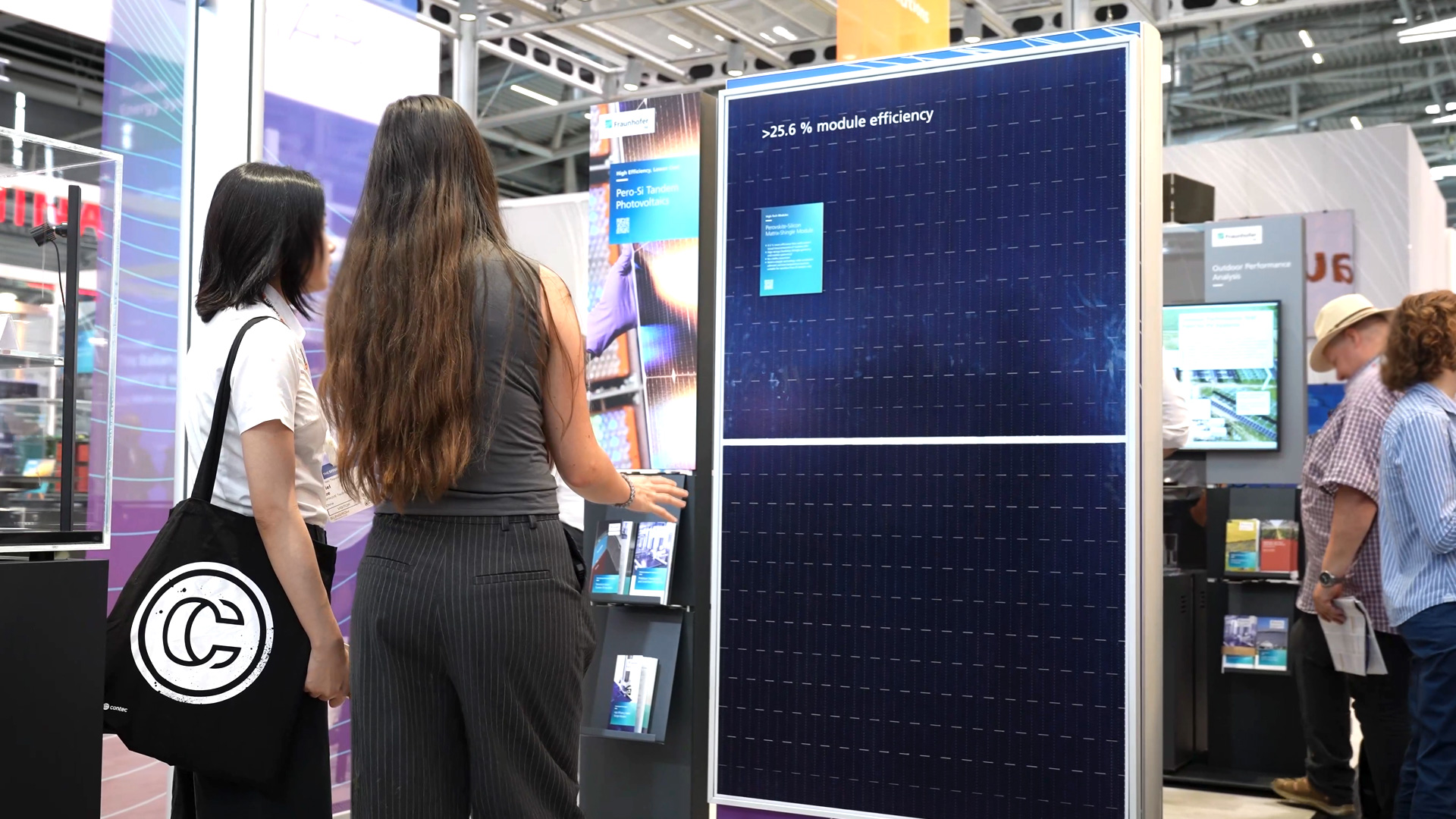
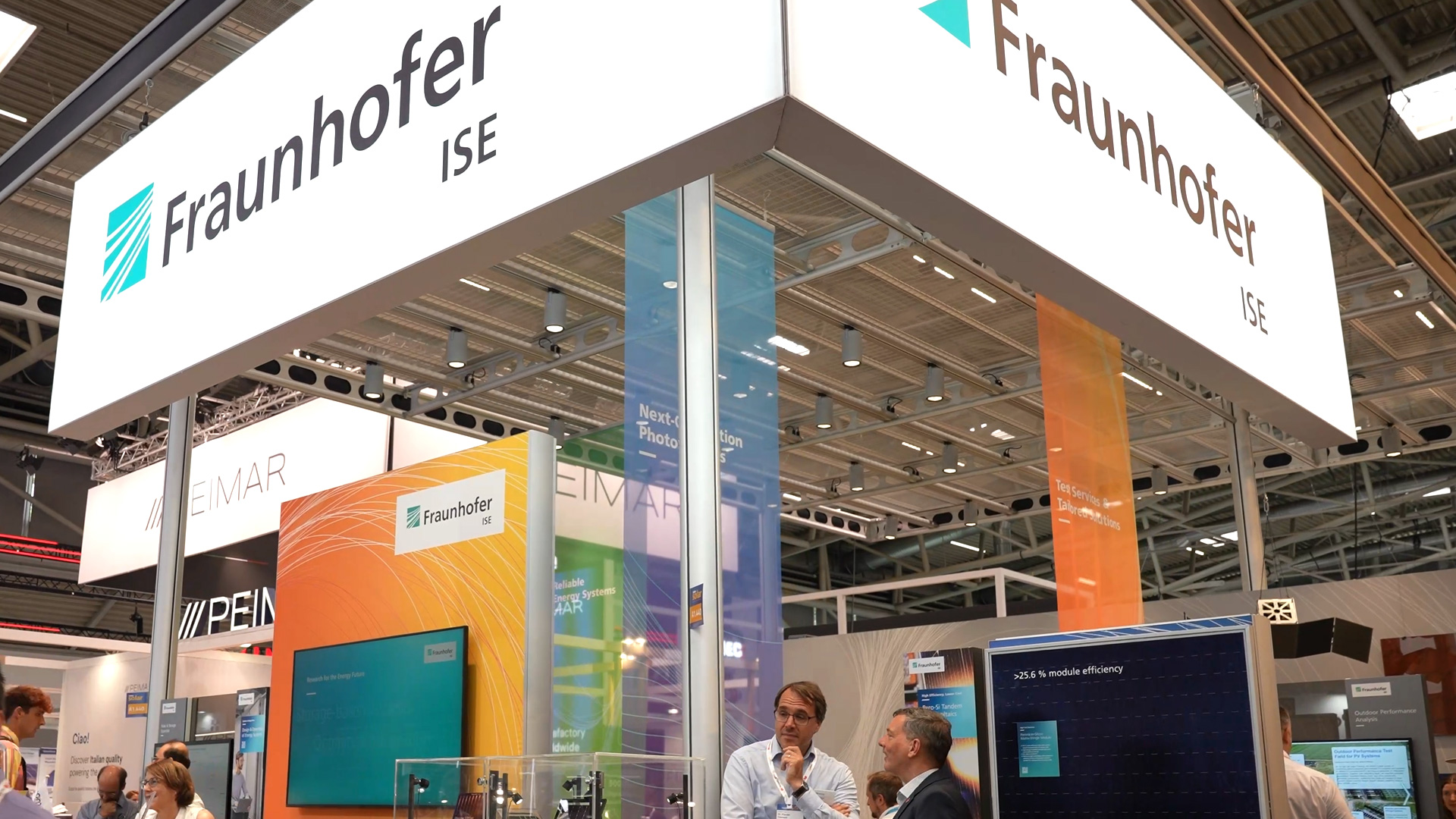
At the same time, however, it is becoming apparent that cell chemistry alone does not determine output. The arrangement of the solar cells within a module also influences how efficiently incident sunlight can be utilised. At Intersolar Europe in Munich, Fraunhofer ISE presented a demonstration module that combines several of these developments. The focus is on perovskite-silicon tandem cells combined with shingle-matrix technology. The aim is to increase the active module area, achieve higher efficiencies and, at the same time, open up new applications for photovoltaics.

Fraunhofer ISE combines tandem cells with shingle-matrix technology
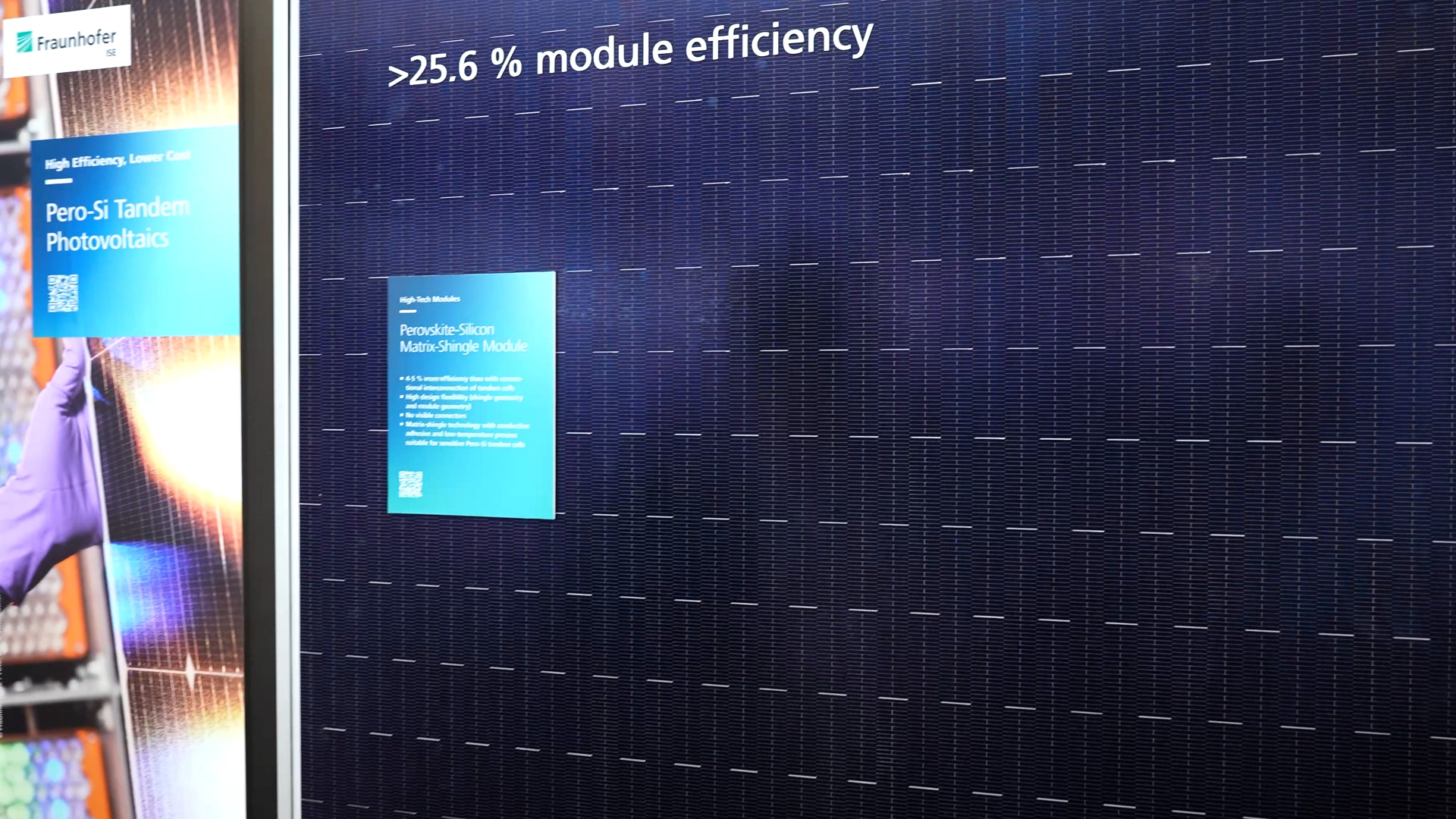
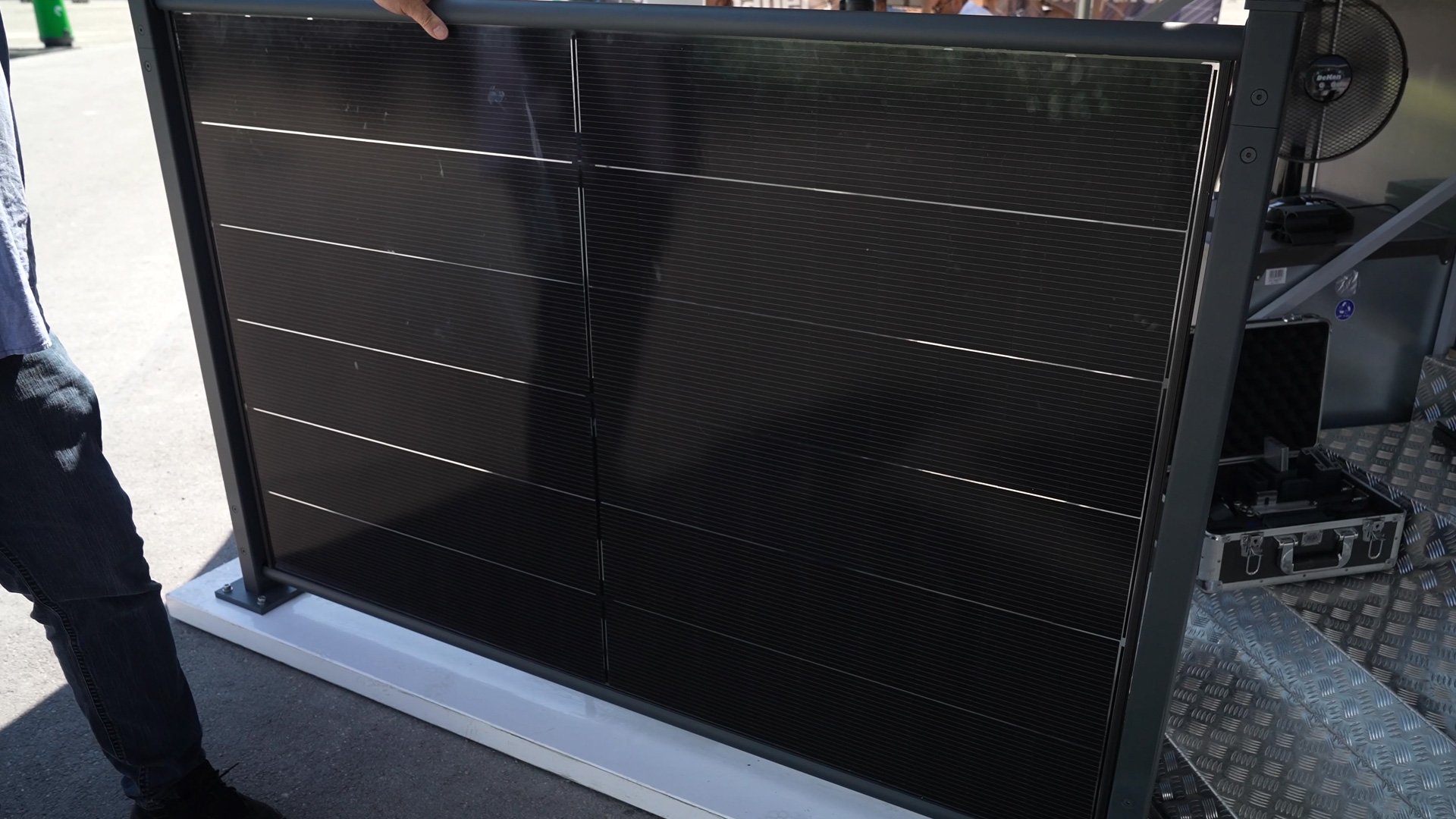
Fraunhofer ISE has been working on perovskite-silicon tandem cells for years and, together with research partners, has already achieved efficiencies of more than 25 per cent. The module now on display complements this cell technology with a design that originally stems from module technology. In shingle-matrix technology, solar cells are not installed in their original form. Instead, they are cut into narrow strips and arranged in a slightly overlapping pattern, similar to roof tiles. This virtually eliminates the gaps that would otherwise exist between the individual cells. This increases the proportion of the surface area that can actually convert sunlight into electrical energy. At the same time, it creates a more uniform appearance, as conductive connections and gaps are significantly less visible. The combination of high-performance cell technology and optimised module architecture is designed to further increase efficiency without increasing the module’s surface area.
Shingle modules offer advantages in terms of shading and curved surfaces
In addition to the higher area utilisation, this design also improves performance under partial shading. If a conventional solar module is partially shaded, this can significantly reduce the output of a large area of the cells. With the shingle structure, this loss of output is less pronounced. This makes such modules particularly suitable for locations where temporary shading occurs or where the geometry of the surface poses specific challenges. The narrow cell strips can be adapted more easily to curved shapes than traditional large-format solar cells. The key features of shingle-matrix technology include:
- overlapping solar cells with virtually invisible gaps
- larger active area for power generation
- improved shading resistance
- Use on curved or complex-shaped surfaces
- Combination with perovskite-silicon tandem cells for higher efficiency
Fraunhofer ISE continues to develop photovoltaics for vehicles
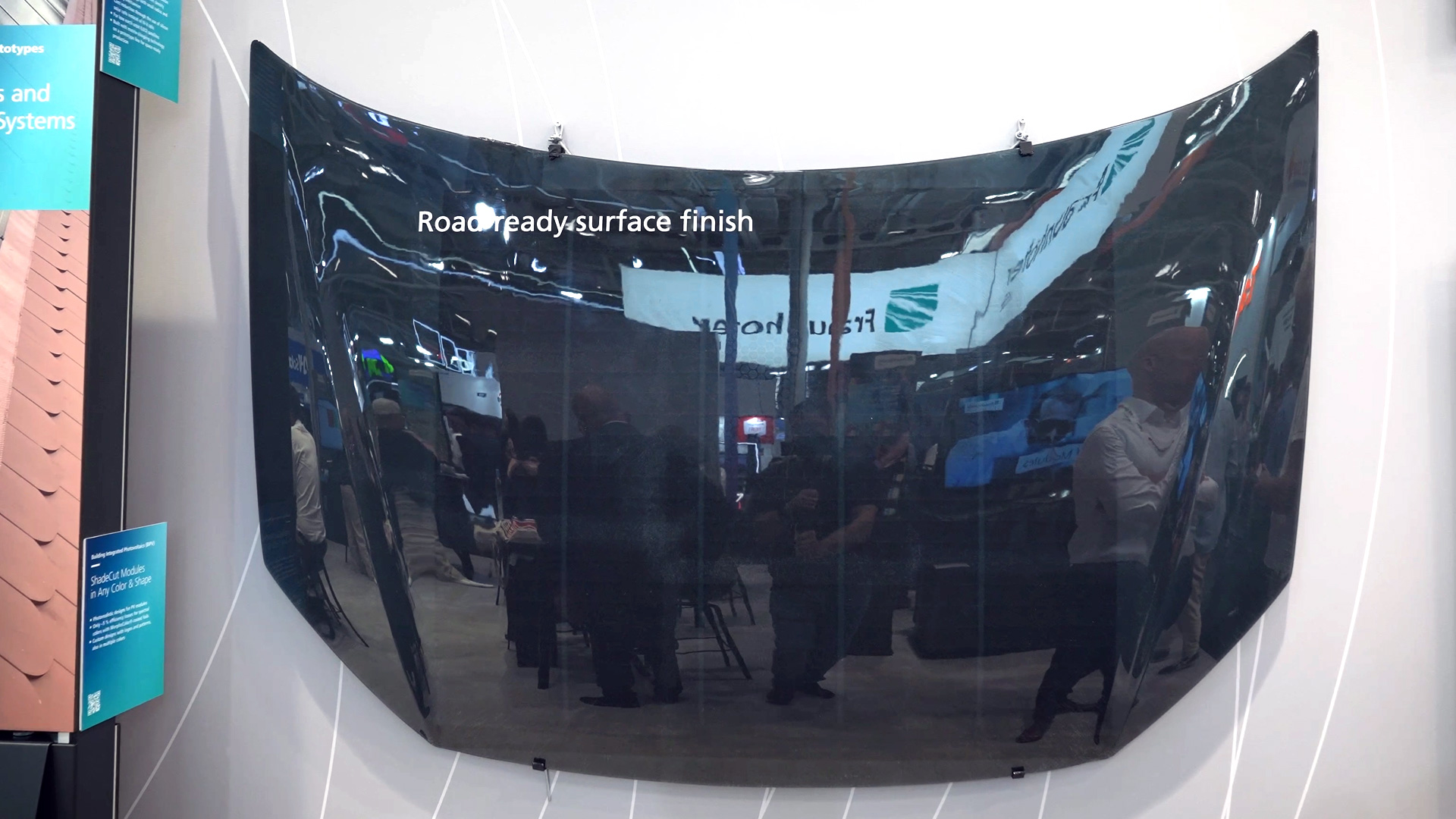
Another key area of research focuses on the integration of photovoltaics into vehicles. Several years ago, the institute began working with car manufacturers to investigate shingle technologies for curved bodywork components. Among other things, a bonnet was presented at the trade fair whose surface meets the quality requirements of the automotive industry. The photovoltaic cells are integrated in such a way that they blend visually into the vehicle’s surface whilst also being designed to withstand long-term stresses caused by weather, stone chips or mechanical strain. The requirements differ significantly from those of conventional solar modules on roofs. Vehicle components must not only generate electricity but also be waterproof, durable and mechanically robust. Added to this are design specifications and the need for integration into existing manufacturing processes. The institute also sees potential for commercial vehicles. Solar roofs on lorries or transport vehicles are gaining in importance, with lightweight modules being particularly in demand to keep the additional weight to a minimum.
Morphocolor enables coloured solar modules with minimal power loss
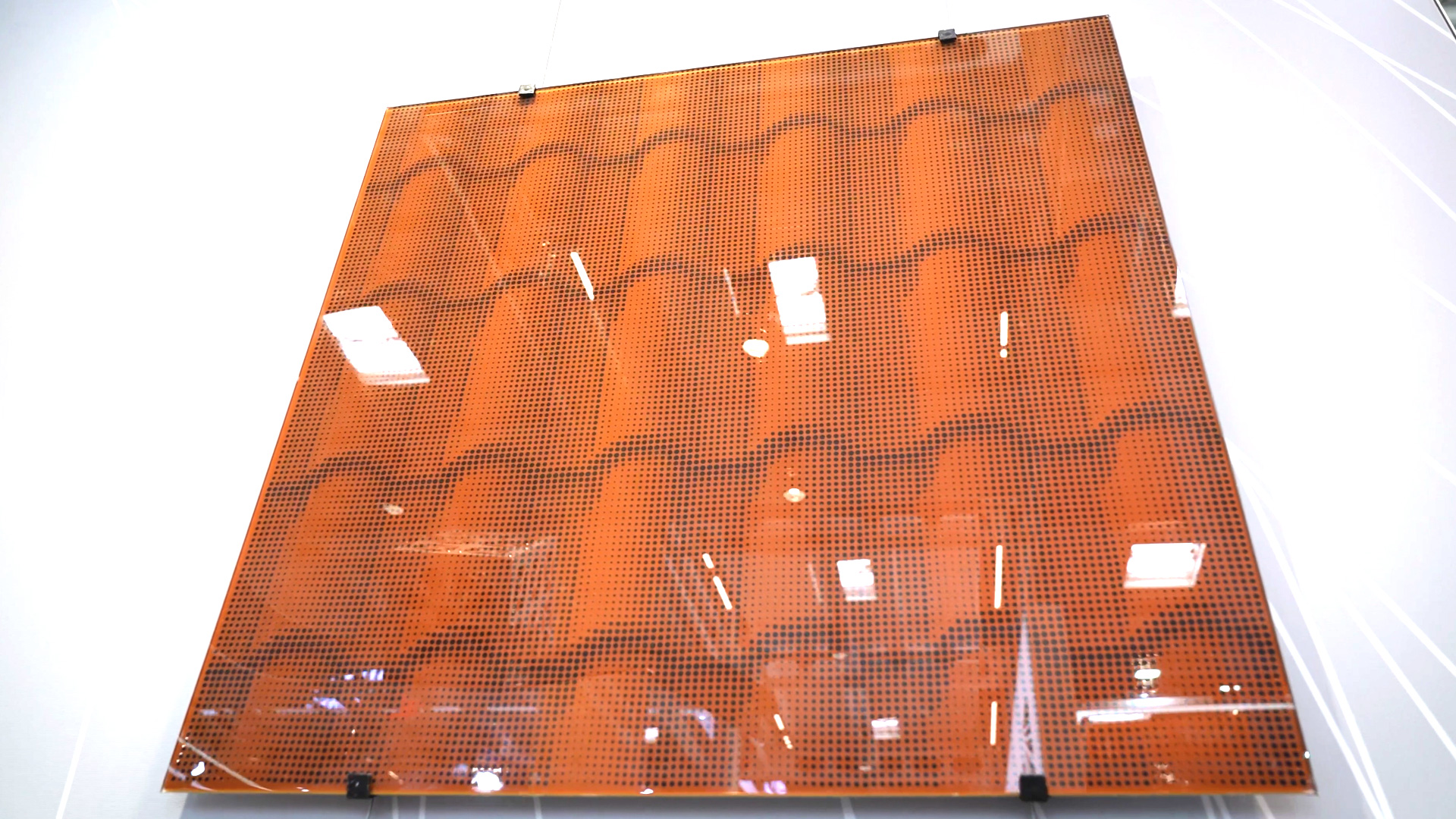
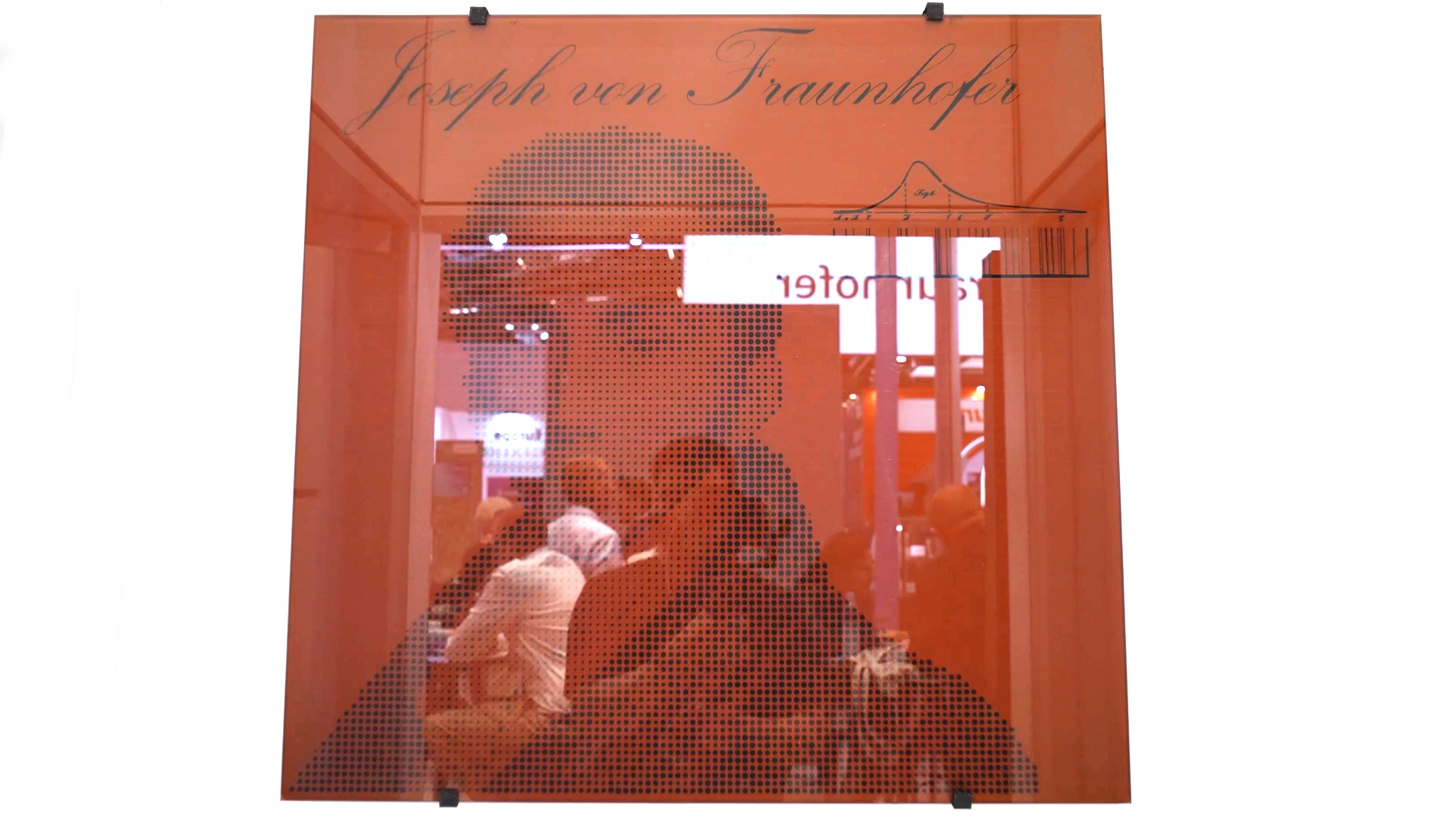
In addition to efficiency and formability, the Fraunhofer ISE also focuses on the visual design of photovoltaics. One example is the so-called Morphocolor approach, which is modelled on the wing structures of certain butterflies. Special surface structures produce intense colours without reducing light output as significantly as with conventional coloured coatings. This opens up new possibilities for building-integrated photovoltaics, where appearance plays an important role alongside energy yield. The current stage of development goes one step further. Individual areas of the module surface can be selectively coloured, whilst others remain black. This makes it possible to create patterns, graphic elements or even roof-tile-like structures. For residential buildings or architecture in historic areas, this results in a more uniform appearance without having to forego photovoltaics entirely.
Research aims to pave the way for industrial production
Despite technological advances, industrial implementation remains a challenge. According to the Fraunhofer ISE, although funding schemes have been initiated at European level, their implementation at national level still has room for improvement. At the same time, the institute is seeing a resurgence in activity regarding the development of production capacities in Europe. The developments presented show that photovoltaics have long since ceased to evolve solely through higher cell efficiencies. Module design, material usage, design and new fields of application are increasingly taking centre stage. Perovskite-silicon tandem cells, shingle modules and coloured photovoltaics all share a common goal: to enable solar energy to be utilised more efficiently whilst at the same time allowing for more flexible integration into buildings, vehicles and other surfaces.
Trade fair reporting Germany - Trade fair knowledge, dates & events


